

Winter Semester
This course provides a comprehensive introduction to nonlinear, pattern-forming, and complex dynamic systems. Starting with an introduction to nonlinear systems theory (one-dimensional systems, two-dimensional systems, bifurcations, chaos, fractals), it proceeds to discuss pattern formation (Swift-Hohenberg and complex Ginzburg Landau eqn's), adaptive dynamics (fitness landscapes, evolutionary game theory), and finally, the concepts and techniques from non-equilibrium statistical physics (phase transitions, order parameters, symmetry breaking, statistical field theory) and complex networks (random, scale-free networks, preferential attachment). It emphasises analytical methods and geometric thinking supported by numerical techniques.
Summer Semester
This course provides an introduction to quantum and nonlinear optics. Before discussing nonlinear quantum processes, we introduce an intuitive semi-classical model of nonlinear effects. Then, we study the most important nonlinear processes, such as second and third harmonic generation, intensity-dependent effects, difference frequency generation, and parametric processes, which allows the generation of entangled photon states. We begin the discussion on quantum optics by introducing field quantization and quantum coherence functions before moving on to discuss non-classical states of light and decoherence, and conclude with an overview of applications such as quantum information processing.
A critical forum where group members and students dissect high-impact research by studying a landmark-paper and a recent accomplishment in the field, honing their ability to evaluate peer-reviewed work and identify “open-research” gaps.

A common space where group members and students exchange about topics related to software development, our IT infrastructure and share common coding best practices.

Outreach
Modelocking enables the generation of ultrashort pulses of light from laser cavities, a breakthrough that has led to four Nobel Prizes. The process of generating ultrashort pulses is so seamless and reliable that it is easy to overlook that modelocking is a self-organized phenomenon, arguably one of the most impactful in science. Thousands of frequency modes within a laser cavity spontaneously lock their phases, producing pulses that are orders of magnitude shorter than the cavity itself.
Historically focused on uniform pulse trains, modelocking research now explores frontiers like spatiotemporal modelocking, designer soliton molecules, ultra-high repetition rates, and novel pulse patterns, requiring managing of vastly more degrees of freedom and controlling novel instabilities.
Meanwhile, a revolution in complex optics offers new methods for mastering numerous spatial modes and their fluctuations, promising synergies with modelocking that could advance laser physics, complex systems, and numerous applications, including biological imaging, pattern formation beyond the diffraction limit, and material processing.
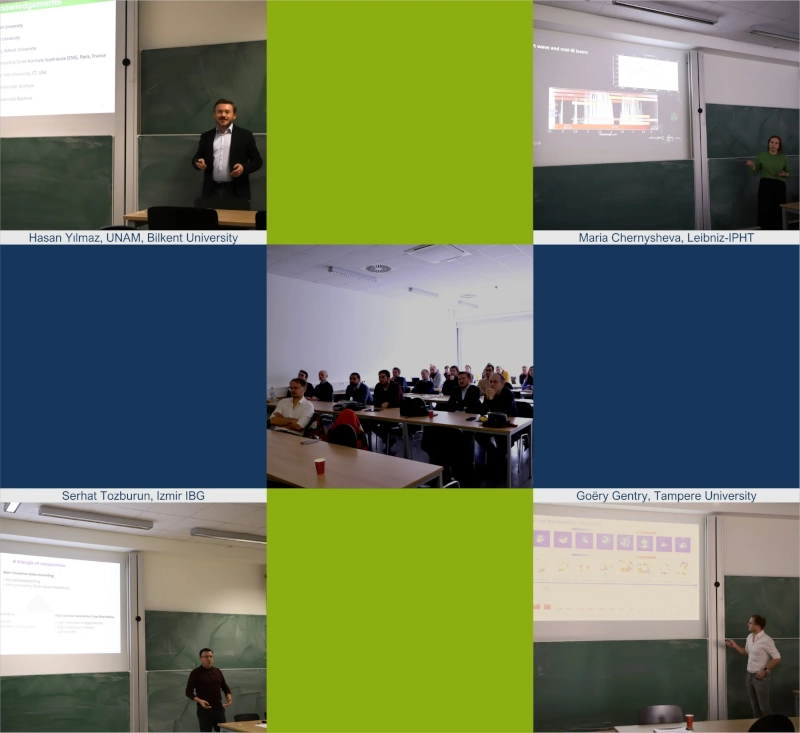
This workshop will bring together experts in modelocking, complex optics, and related fields to explore these synergies and emerging opportunities.
Time: 22 November 2024
Location: ID 3 / 653